Craig Venter, the biologist and entrepreneur who decoded the human genome, has died
Craig Venter, the American biologist and entrepreneur who founded Celera Genomics to launch his own Human Genome Project in 1999 outside the public consortium, died Wednesday in San Diego at the age of 79, according to a statement from the J. Craig Venter Institute, which he led. Among other achievements, Venter completed the first full sequencing of a living organism’s genetic material and announced that he had succeeded in creating synthetic life.
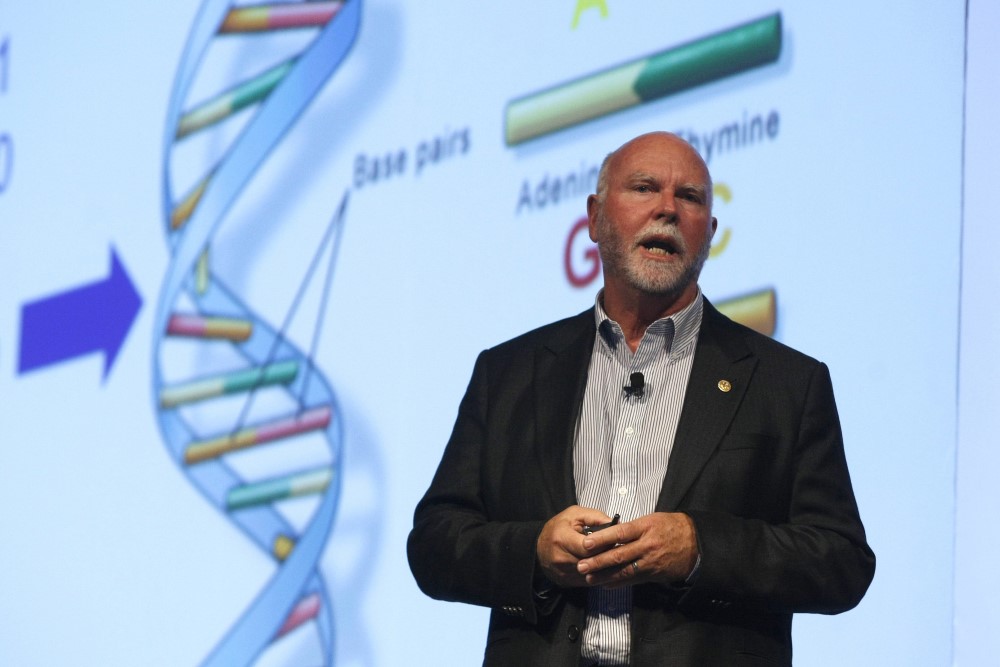
Biologist Craig Venter. EFE/FRANCISCO GUASCO
Marco Milán- muerte Craig Venter
Marco Milán
ICREA researcher at IRB Barcelona
Craig Venter competed with the public consortium to sequence the human genome in the late 1990s. To demonstrate his technological capabilities, he showed the world that he could sequence the genome of a complex multicellular organism, and he did so using the genome of Drosophila melanogaster. A few years later, he published the human genome. The surprise was the high level of gene conservation between a fruit fly and humans. This work catapulted this model organism to the forefront of biomedical research.
Lluis Montoliu - Craig Venter EN
Lluís Montoliu
Research professor at the National Biotechnology Centre (CNB-CSIC) and at the CIBERER-ISCIII
One of the most influential, passionate, combative and ambitious scientists of our time has died. He was undoubtedly a one-of-a-kind figure who deserves to be remembered not for his frequent self-centred stances, but for his contributions.
The race to sequence the human genome in 2001 has been described as a battle between the public project, which began in 1988, led first by James Watson (Cold Spring Harbor Laboratory) and then by Francis Collins (NIH), in collaboration with the Sanger Institute in Cambridge and many other laboratories, and the private project, led by the company Celera Genomics, founded by Craig Venter in 1998. In reality, no such battle existed; it was more a collaboration than a competition.
Craig Venter developed the DNA sequencing method known as ‘shotgun’, based on breaking DNA molecules into numerous small fragments that were easy to sequence, and then reassembling them into the correct sequence. But to do this, he needed external references: a map, a well-established physical map, which was provided by the public project. In other words, both projects needed each other. The map made it possible to know where to place the DNA fragments sequenced by Celera and Craig Venter. And the vast number of fragments they produced enabled the public project to complete the genome as well. The result was a dual publication in February 2001. Craig Venter published his ‘private’ genome in the journal Science, and the public Human Genome Project was reported in the journal Nature.
The scientific community and society at large benefited from this apparent struggle, which turned out to be more of an effective collaboration, a mutual aid, albeit initially a reluctant, bitter contest. But even the proudest and most arrogant of scientists, such as Venter, who wanted to crush and outdo the public Human Genome Project, overwhelming it with his state-of-the-art machines and mass sequencing applications, had to eventually acknowledge that without the general map they had constructed (and freely shared), the public genome project would not have been able to complete the puzzle; they would not have been able to place their millions of small DNA fragments in the correct place. Unity is strength.
Naturally, Craig Venter left his mark on the genome, as one of the five people used to obtain the private genome was himself. Can we think of anything more narcissistic than sequencing your own genome for the rest of the world to use as a reference? That was Venter. But Venter will also be remembered for his contributions to synthetic biology, for having produced the first synthetic cell in the laboratory in 2010. His team engineered the bacterium Mycoplasma laboratorium, splicing together different DNA fragments and genes to create a minimal genome that allowed the resulting cell to self-replicate, despite having been created in the laboratory. This was certainly spectacular, opening up a field that has continued to advance. He also deserves to be remembered for his pioneering initiatives in obtaining metagenomes from nature. In other words, sequencing DNA present in ecosystems and, from there, deducing the genomes of the microorganisms present and discovering new genes with potential applications.
We bid farewell to a towering figure, someone who, despite his flaws, managed to have his name associated with one of the most significant undertakings we humans have ever set ourselves: to be the first and only species capable of reading and interpreting its own genome. Nothing more and nothing less.
Ángel Raya - Craig Venter
Ángel Raya Chamorro
ICREA Research Professor and Coordinator of the Regenerative Medicine Programme at the Bellvitge Biomedical Research Institute (IDIBELL), member of CIBER-BBN, Director of the Clinical Translation Programme in Regenerative Medicine in Catalonia, and Professor of Physiology at the University of Barcelona.
He was certainly a remarkable figure… We have lost one of those figures who split the history of science in two. For those of us working in developmental genetics, his legacy is not merely technical, but vital: I remember the mixture of unease and fascination when our laboratory subscribed to the Celera Discovery System, his private search engine. It caused me a huge conflict: the ‘right’ thing, the straight and narrow path, was the public project; Venter’s venture represented the private sector, with its haste and ambition to secure patents. But the reality is that that tool allowed us to undertake projects that were previously unthinkable. And that tension, that paradox between the public and the private, is an inescapable part of his history and of ours.
Justo Castaño - Craig Venter EN
Justo P. Castaño
Professor of Cell Biology in the Department of Cell Biology, Physiology and Immunology at the University of Cordoba and researcher in charge of the Hormones and Cancer group at the Maimonides Institute of Biomedical Research of Cordoba (IMIBIC)
Who isn’t familiar with his excessive self-promotion and his role in the Human Genome Project? I mention his name and his main, best-known project in my Master’s in Biomedicine classes to explain what his initiative meant for the truly revolutionary transformation that our understanding of the human body has undergone at the start of the 21st century. A turning point, quite literally.
I consider him a visionary who turned what for many was unthinkable or impossible into an achievable challenge. It is true that he is surrounded by much controversy because his views on too many matters are more than just questionable, but it would be difficult to understand our knowledge of the human genome without his transformative drive. When he spearheaded the proposal to sequence the human genome, the cost of doing so was estimated to exceed 3 billion dollars, and amongst other controversial decisions, he placed himself at the centre of the project, ensuring that his own genome was also sequenced.
Today, a human genome can be sequenced for less than €500, and sooner rather than later it will be possible to do so for just over €100. That all this has happened in less than 30 years is truly impressive.
Part of the progress made during this period is due to controversial and unique figures such as Craig Venter. The perspective of time will allow us to assess, with objective criteria, the true contribution to scientific progress of the initiatives he led.
Sebastián Chávez - Craig Venter
Sebastián Chávez de Diego
Professor at the University of Seville and member of the Gene Expression in Eukaryotes group
I would highlight his visionary nature and his ability to introduce business management practices into large-scale scientific projects, first in the Human Genome Project, and later in the field of synthetic biology. He set himself goals that seemed out of reach and introduced a way of doing things that was unknown in academic science. This earned him a reputation as a maverick who was tainting the pristine world of basic research, but ultimately he was a driving force of the highest order in achieving objectives of the highest order. If I had to highlight one of his achievements, I would choose the fact that he succeeded in synthesising the complete genome of an organism for the first time and making it function as a self-replicating entity. I consider this the greatest milestone in the materialist concept of life.
muere craig venter - francisco martínez abarca
Francisco Martínez-Abarca
Researcher in the Department of Soil and Plant Microbiology, Zaidín Experimental Station-CSIC
He was one of the scientists responsible for the major changes that took place during the transition from the 20th to the 21st century, the era of genomics. Venter was a brilliant and controversial scientist, both in his scientific work and as an innovator. In the late 1990s, most approaches to DNA sequencing for any living organism were extremely labor-intensive and costly. As a visionary, he insisted that starting at the top was the fastest and cheapest way. Through his company, Celera Genomics, he spurred an explosion of DNA sequencing services across laboratories worldwide, marking a shift in how science is conducted and influencing the development of new disciplines such as bioinformatics, microbiology, evolutionary biology, synthetic biology, and human genome sequencing… These advancements forever transformed the landscape of biological databases.
Without a doubt, he is one of the scientists to whom modern science owes a great debt of gratitude, though perhaps his controversial ambition has prevented him from receiving the recognition he deserved. Many current genomic research groups are indebted to him; may he rest in peace.
Ana Dopazo - muere Craig Venter
Ana Dopazo
Head of the Genomics Unit at the National Centre for Cardiovascular Research (CNIC)
I’m still surprised when, during talks at high schools or universities, no one has heard of Craig Venter. In the Human Genome Project, he led the private-sector effort with his company Celera Genomics, competing head-to-head with the public initiative led by Francis Collins. They published the project’s drafts “back-to-back,” as shown on the covers of *Nature* and *Science* in 2001. Venter was the first person to sequence his entire genome (2007, The Diploid Genome Sequence of an Individual Human). Another controversial figure, James Watson, was the second person to sequence his entire genome. The Human Genome Project was followed by synthetic biology, with its own controversies.
Jordi Pérez-Tur muere Craig Venter
Jordi Pérez-Tur
Research scientist at the Public Research Organisation (PRO) at the Institute of Biomedicine of Valencia of the Spanish National Research Council (CSIC) and principal investigator at CIBERNED
The death of Craig Venter marks the loss of a pioneer in the truest sense of the word. He expanded the frontiers of genetics as no one had done since the late 19th century. His approach to making rapid progress in sequencing the human genome was crucial to reaching that milestone in 2003, 50 years after the discovery of DNA’s double-helix structure.
Venter was a pioneer, not without controversy, who established several research institutes (TIGR, in 1992, which later became part of the J. Craig Venter Institute in the early years of this century), companies (Celera) and, above all, led projects that not only broke boundaries but surpassed them with spectacular innovations. His approach to sequencing the human genome came as a shock to the public programme, with a different methodology that would have required far more time to achieve its goal without EST sequencing—a technique born of the ingenuity and vision of Venter and his team. In recent years, his focus had been on the creation of synthetic cells, a rapidly expanding field.
I met him on a couple of occasions and was struck by his mental agility, the clarity of his objectives and the path he had mapped out to achieve them. He was a scientist of great intelligence, dedicated to advancing our understanding of biology. He understood where some of the key obstacles lay that needed to be overcome to open up those frontiers he loved to cross.
Although it may sound like a cliché, we bid farewell to a figure who was surely one of a kind, and of whom there are few examples in every generation.